
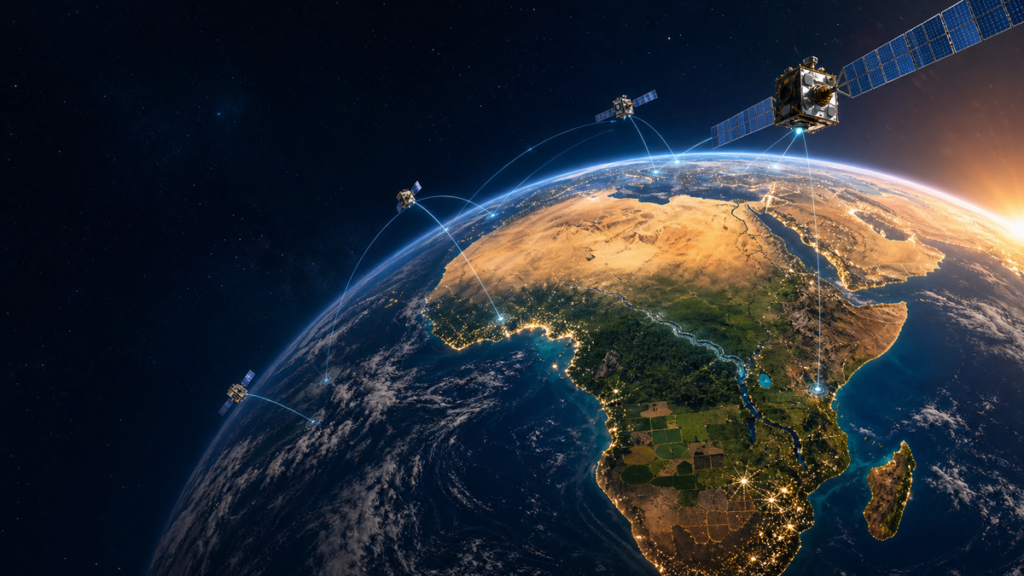
For decades, outer space was the exclusive domain of a handful of superpowers—the United States, Russia, and a small circle of technologically advanced nations. Today, that landscape is changing rapidly. From the plains of Kenya to the deserts of Algeria, African nations are joining the space race in unprecedented numbers, driven by falling costs, broader technology access, and a growing recognition that satellite data holds the key to solving some of the continent’s most pressing challenges.
The numbers tell a compelling story. As of 2025, 61 African satellites orbit the Earth—a remarkable figure given that just thirty years ago, the continent had none. By the end of 2025, that number had grown to 68 satellites launched by 19 African countries. More than 21 countries now have space programmes, with 18 having placed at least one satellite into orbit. Egypt and South Africa lead the continent with 13 satellites each, followed by Nigeria with seven and Algeria with six. This is no longer a niche pursuit; it is a movement.
A Historic Milestone: The African Space Agency
The continent’s space ambitions took a giant leap forward on April 20, 2025, with the official inauguration of the African Space Agency (AfSA) at its permanent headquarters in Cairo’s Egyptian Space City. The event marked the culmination of nearly a decade of planning, following the African Union’s adoption of a continental space policy and strategy in 2016.
AfSA’s mandate is ambitious: to coordinate space activities across the continent, support national and regional programmes, and drive applications in Earth observation, satellite connectivity, astronomy, and navigation and positioning. As Tidiane Ouattara, president of the African Space Council, put it: “From agriculture to security, from climate monitoring to disaster response, Africa’s survival and prosperity depend on its ability to harness space technologies”.
The agency has already signed cooperation agreements with the European Space Agency (ESA), the UAE Space Agency, and Russia’s Roscosmos. The ESA partnership alone forms part of a €100 million programme aimed at strengthening early warning systems, expanding Africa’s space data economy, and boosting capacity. AfSA also serves as a platform for enhancing cooperation among African countries, exchanging expertise, building capacities, and unifying African positions in international forums.
The Data Revolution
What makes this moment truly transformative is not the number of satellites in orbit, but the data they generate. For the first time, African nations have greater access to satellite systems than ever before, enabling them to utilise more data across virtually every sector of the economy.
**Agriculture and Food Security** is perhaps the most immediate beneficiary. Across the continent, Earth observation data is being used to monitor crop health, predict yields, and detect early signs of drought. In semi-arid regions like Tunisia, satellite data helps manage water resources for agriculture, improving irrigation efficiency and ensuring sustainable crop production. Tanzania’s Sokoine University of Agriculture has adopted open Earth observation tools to track crop performance patterns across growing seasons using Sentinel-2 data. The Cropland Extent Map now provides a high-resolution view of where crops are grown across Africa—critical information on a continent where much farming happens on small, fragmented plots.
**Climate Resilience and Disaster Management** is another critical application. The Climate Camera (ClimCam)—a joint project between Kenya, Egypt, and Uganda—was launched to the International Space Station in April 2026 aboard a SpaceX Falcon 9 rocket. The payload delivers near-real-time, AI-powered weather and climate data to strengthen disaster management and climate resilience across Eastern Africa. Meanwhile, the GMES & Africa programme—a continental Earth observation initiative—is providing data on wetlands and flood-prone areas, enabling better land and water management. Along the coast of Ghana, EO data is being used to track fish stocks, helping protect marine biodiversity critical to local food systems.
**Connectivity and the Digital Economy** is being revolutionised by Low Earth Orbit (LEO) satellites. Africa’s LEO satellite market is estimated at approximately $320 million in 2025 and is projected to reach $780 million by 2030, representing a compound annual growth rate of about 19%. LEO satellites are reaching households and small businesses that had no broadband before, bridging the digital divide that has long held back African development. In Central Africa, where rivers account for 80 percent of economic transactions, EO data enables safer navigation by monitoring water levels, reducing accidents and supporting trade.
**Natural Resource Management** is also benefiting. Space technologies help African nations manage natural resources, counter illegal mining, monitor transportation, improve navigation, and build climate resilience. In Ethiopia, a domestic platform is being developed to ensure that satellite data is translated into actionable, context-specific intelligence aligned with the country’s societal and institutional needs.
The Economics of Africa’s Space Ambition
The economic implications are substantial. According to Space in Africa, the African space economy was valued at $24.95 billion in 2024 and is forecast to grow to $39.52 billion by 2030. African NewSpace companies collectively generated $373.35 million in revenue in 2024, with over 300 firms operating across 36 countries. The sector is projected to reach $580 million by 2030.
These figures, while modest compared to the global space economy of $500 billion, represent a significant and growing opportunity. As the African Space Agency works to enable regulatory frameworks, support public-private partnerships, and help develop a market for satellite services, data applications, and indigenous innovation, the potential for growth is immense.
International Partnerships and Geopolitics
Africa’s space ambitions have not gone unnoticed by global powers. China has been particularly active, signing 23 bilateral space partnerships with African nations, including funding for satellites and ground stations to collect satellite imagery and data. Beijing’s long-term presence in African space projects grants it access to surveillance data and strengthens its strategic foothold on the continent. Several African nations, including South Africa and Senegal, are exploring cooperation with China on a future moon base, positioning themselves in Beijing’s long-term space strategy.
Meanwhile, the United States has been urged to shore up its own space alliances in Africa. As one analysis noted, “Africa’s space sector presents significant opportunities for the United States,” and the U.S. “will need to take a collaborative approach” to harness these opportunities. The European Space Agency, through its Dunia platform, is providing African researchers and institutions with a streamlined interface to analyse satellite data, while also enabling collaboration through its online marketplace.
Challenges Ahead
Despite the momentum, significant challenges remain. Africa’s 61 satellites barely register amid the mega-constellations from other continents—Starlink alone had 8,877 satellites in orbit as of June 2025, with 40,000 ultimately planned. The cost of duplicating such a feat is beyond the capacity of Africa’s private sector, meaning space programmes remain largely government initiatives.
Financing is a persistent struggle, given the pressing socio-economic needs of developing nations. African governments collectively devoted only a few hundred million dollars to space activities in 2025. Budgets remain modest by global standards, and many countries face steep technical and financial hurdles, along with underdeveloped national regulations and legal frameworks.
There is also the risk that AfSA’s potential could be hamstrung by a lack of active participation from member states. As one expert warned, “AfSA needs to be practical and implementation-driven. There’s momentum, but we must now see real action. Otherwise, it risks becoming another talking shop”.
A New Era for Africa
The philosophy underpinning Africa’s space ambitions is clear: data obtained from satellites will facilitate socio-economic growth and is worth the investment. The African Space Agency’s creation is a signal that Africa intends to play a significant role in global technology and scientific discovery.
As Dr Tidiane Ouattara observed, “Space is no longer abstract for Africa. It’s a practical tool for protecting resources, improving livelihoods and strengthening the economy”. From monitoring crops and managing water resources to predicting disasters and connecting the unconnected, satellite data is transforming how Africa addresses its most fundamental challenges.
The continent is still a newcomer to the space race, but it is arriving with purpose. With 68 satellites in orbit, a continental space agency now operational, and a space economy projected to reach nearly $40 billion by 2030, Africa is demonstrating that the stars are not just for the powerful few—they belong to Africa too.